17 Dec 2006

Review - Ravikumar Kashi

Bangalore based artist Ravikumar Kashi's recent set of paintings previews in Bangalore on Dec 20, 2006. The exhibition will then travel to Chennai, Palo Alto - California (USA) and London, UK.

Since, I had to do a write-up for the Sunday Times of India, on a bright Sunday morning I braved the by-now ill-famous Bangalore traffic and met him at his studio. Over a cup of coffee, we discussed his art, the process by which he arrives at his compositions, his poetry and writings, Bangalore's promising art scene, contemporary Indian art in general and a lot more. The works were refreshing (and, so was the coffee) and I came away impressed with his interpretations of 'urban experiences'.

The following article was published today in TOI, Bangalore (Dec 17, 2006)

Paradox of Urbanisation

Bangalore based artist Ravikumar Kashi’s works offer remarkable insights into the paradoxical aspects of modernization and urbanization. The layers on his canvas reveal the intricacies and dynamics related to media excesses and social paradigms. Ravi takes inspiration from current events and his surroundings; he collects images and text that interest him. A look into his scrapbook reveals a fascinating collection of assorted images from advertisements, photographs and text from magazines and even email ids. His notebook is filled with rough sketches and scribbled notes, which then form the basis of his artworks.
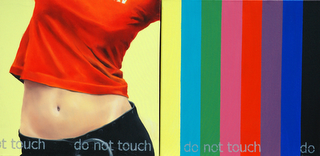
'Do Not Touch' by Ravikumar Kashi, image courtesy artist
Ravi has continuously evolved as an artist; over the years, he has experimented with various mediums - he has worked with paper pulp, found art, printmaking and glass painting in the past. And, now in the current series of paintings there is greater maturity where the visuals are more open-ended and encourage further viewer interaction. Incidentally, he has a Masters degree in printmaking from MS University, Baroda, and in English from Mysore University. A writer and a poet, Ravi has also published interviews with artists for newspapers.

What he is particularly adept at is in presenting the contrast or conflict between accepted norms as he combines unrelated images to magnify the non-apparent similarities and differences. The unraveling of layers and arriving at the inter-relation of separate frames in his paintings forms an exciting process by itself. ‘Happily ever after’ explores the relationship between a couple, where a pile of boxes on the lower side of the canvas hints at revealing new surprises in the relationship when pulling out each box. ‘Say something’ depicts a corpse like figure completely still and static with an overlapping flight map that talks about movement and connectivity. The irrelevance of tickers on the television screen on news channels talks about segmented viewing, and compartmentalization of our lives in general. According to Ravi Kashi, “Often we see an advertisement of a beauty product on one page of a magazine with a model turned out exquisitely, while on the opposite page is an image of a young girl suffering from draught.” The incongruity of events and images in media is what influences Ravi in his art.
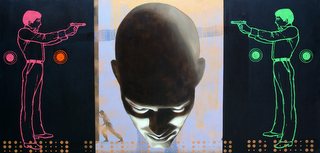
image courtesy artist Ravikumar Kashi
On one hand the society abhors violence and killing, and at the same time most videogames (even for children) allow them to score points based on the number of killings made! His large 10 x 5 feet work titled ‘Go Play’ deals with this theme. The painting raises issues of morality and the society’s response in varying scenarios. The other works are also along similar lines; they deal with notions of power, urban stress, expectations, consumerism, materialism and so on. Most of his paintings have textual messages that highlight the absurdity of urban patterns. The text varies from Morse code, Braille, sign language, email ids and even banner ads.

Another set of visuals made in paper pulp forms a separate collection akin to pages from a journal. These combine images and text in random order and are also based on contemporary topics. Occupying an informal space in the exhibition, these are equally thought provoking and raise pertinent questions on urban trends.

The exhibition begins on December 20 at Gallery Sumukha, Bangalore.
13 Dec 2006

Art Buzz (Dec 15, 2006)

All updates are for Bangalore

Dec 15 - 17 The language of art - paintings by Rajendra Kedige at Karnataka Chitrakala Parishath.
Painting at Kynkyny
Dec 15 - Jan 5 An exhibition of paintings by Prakash Kurchagi and Praveen Kumar at KYNKYNY.


Dec 16 - 23 'Kolkata Kaleidoscope' an exhibition of paintings by Asit Sarkar, Ballari Mukherjee, Dhiren Saha, Kalyan Mukherjee, Debabrata Sarkar and Sukhendu Saha at Gallery G.

Dec 16 - 18 Art in Nature - a photographic exhibition by Suresh Ganapathiappan at Karnataka Chitrakala Parishath.

Dec 16 - 22 A Chorus Line - a travel art show by Krishna Raichur, Prakash Nayak, Rani Rekha, Venkatesh, Varna Sindhu at Galerie Sara Arakkal.

7 Dec 2006

Review – Group show by Kolkata artists

In this group show curated by Akumal Ramchander, there is an attempt to bring qualitative works at reasonable prices. Amongst the sixty odd paintings on display, there is quite a variety in terms of themes, styles of painting and also the mediums that have been used. The artists themselves form an eclectic group where a couple of them are in their early 20s and still studying, while others are at varying levels of their careers.

According to Akumal, he handpicked these eleven Kolkata based artists and encouraged them to create works that are not mundane or conventional. The themes may be universal but Akumal guided them when it came to the final presentation on the canvas. The results are definitely interesting and fortunately the experiment has generally worked, where most of the works are a little ‘different’, however a few fall short of expectations.

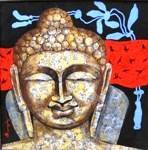
The collection features figurative works of Buddha, Krishna, Goddess Durga, adolescent girls, still life – flowers, vases, abstract lily ponds, and a few landscapes. Atin Basak, Prabir Das, Sudipta Tewary and a few others are fairly well established artists and their works are worth seeing. Basak’s etchings on paper stand out for their sheer luminescence, the graceful compositions along with the clever use of colors create a wonderful effect. Sudipta Tewary’s charcoal drawings are also skilled and the human faces are full of enigma (incidentally Tewary is a self taught artist). Prabir Das zeroes on an unusual subject – owls, he presents them against theatrical backgrounds, combining unusual elements such as flowers and scarecrows along with them. In one of the works an owl is perched on a scarecrow in the middle of the night while bright yellow flowers gleam in the surrounding darkness - the effect is quite dramatic and startling.
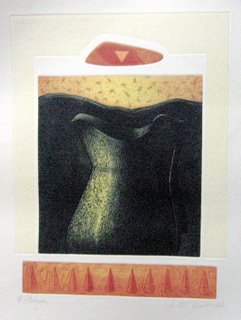
Etching on paper by Atin Basak, image courtesy artist Image courtesy artist
Subrota Sen’s impressionist style lily ponds in large format are a delight to watch, not in the same league as Monet, but nevertheless very pleasant. Unfortunately, the smaller floral works are fairly dull and appear a little contrived. The still life paintings by Swapan Saha are also pleasing to the eye and the works in mixed media on board by Dhiren Shasmal, an illustrator and painter, have a lot of detailing. The other figurative works by Ashoke Ganguly and Milan Das, and abstracts by Aruava Mondal are also interesting. In the collection, the landscapes are a little disappointing and the colors are too garish. Overall, the show is worth a look. Prices start at Rs 10,000.

The exhibition is on till December 11 at Time and Space art gallery, Bangalore.

1 Dec 2006

Art Buzz (Dec 1, 2006)

"PAST FORWARD" (paintings and drawings) and "PAINTED WEAVES" (tapestries) by SG Vasudev at Jehangir Art Gallery, Mumbai previews on Monday, December 4.

Dec 2 - 11 An exhibition of paintings by eleven artists from West Bengal at Time and Space Art gallery, Bangalore.

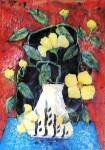
Painting by Ashok GangulyPainting by Swapan Saha
Dec 2 - 10 An exhibition of paintings and photographs by Ranjini Vikram, Manjunath Kalledevar and KK Makali at Lakshana Art gallery, Bangalore.

Review - Paresh Hazra

Paresh Hazra’s recent works are influenced by rural Bengal - the paintings are colorful and have a lot of folk motifs. This particular series is based on deities from Hindu mythology such as Krishna, Ganesha and Durga. Most of the works are in earth tones with golden highlights, and the result is quite stunning if over-embellished. The colors and textures in this series are toned down as compared to his last exhibition in the city.

Image courtesy Paresh Hazra
Born in West Bengal, Hazra came to Bangalore in 1981 as an art teacher at the Military School. In his early days, Hazra worked with watercolors using the wash technique popular in the Bengal School. Fond of experimentation, he constantly tried out different mediums such as watercolor, graphics, oil painting and mural. He recalls that when he was learning the fresco technique and egg tempera – where egg yolk, linseed oil and mastic varnish are mixed, he discovered his preferred medium. He writes, “…I completely transformed it (egg tempera technique) into my own way intending to bridge the traditional and contemporary themes and motifs of India.” He also experiments with the texture of surfaces by using bits of string, jute or gauze on canvas. Incidentally, egg tempera medium has its origins in Europe and a number of famous paintings by old masters were done in this medium till the fifteenth century. Once oils were discovered, artists found the freedom to paint outdoors and egg-tempera became less popular over the centuries.
There are a couple of abstracts in paper pulp and a few charcoal drawings also. The charcoal portraits are pleasantly minimalist and stand out amongst the profusion of colorful paintings.

The exhibition is on till December 8 at Right Lines Art Gallery, Bangalore.