18 Mar 2009

So much to see

(By Nalini S Malaviya)

A Sculptural Lineage
A sculpture show by Chennai based artist V.R Raviram previewed last week and presents his recent series titled A Sculptural Lineage. A majority of his works resonate with folk art elements and traces of Cholamandal style. The sculptures appear to be heavily influenced by renowned sculptors P.V.Janikiram (his uncle) and also S Nandagopal, but probably this has more to do with the Cholamandal aesthetics that experimented with frontal sculpture and elaborate embellishment on the metal surface.


Traditional motifs, mythological figures, animals and birds form the themes in copper. There is a small set of works that are radically different from the conventional decorative mode and are meant to be more contemporary. A simple and minimal approach has been adopted here. It could not have been easy for Raviram to break away completely from his old style that he has perfected over the years. One looks forward to his new works and see how he balances the two diametrical opposite styles and sensibilities.

(The exhibition continues till March 25 at Gallery Mementos, Bangalore – 1)


Myth and movement
The other exhibition Myth and movement is a thematic show that exhibits the recent works of four artists Seema Kohli, Ramesh Gorjala, Atul Talukdar and Dimpy Menon and explores “ideas of myths and cosmic energies and movements of forms in space”.
Seema, a self taught artist indulges in a quest for the spiritual and self. Her elaborately executed canvasses are rich in details with every inch of the canvas covered meticulously. Repeated patterns and motifs add an element of design while gold leaf embellishment gives it an exotic look. Ramesh presents traditional myths and folk arts with a contemporary touch. Kalamkari motifs form the backdrop in most of his works.


Dimpy’s sculptures are minimalistic in their approach, and lyrical and graceful in their form with emphasis on the finished surface. Atul, an artist from Bangladesh also presents bronze sculptures of human figures such as musicians and dancers. There is a distinct earthy appeal to his works.


(The exhibition continues till March 31 at Mahua Art Gallery, Bangalore – 80.)


For a good cause
Incidentally, another art exhibition A Wonderful World, a benefit for the New Delhi-based NGO Four Steps (a research, training and rehabilitation centre for Children with special needs) will be held in Bangalore. Works by artists such as Jamil Naqsh, Amiya Bhattacharjee, Kamar Alam and Seema Kohli amongst others will be part of the show to be held between March 18th - 20th, 2009 at Olive Beach.


Published in Bangalore Mirror

12 Mar 2009

Critical acclaim or popular choice

(By Nalini S Malaviya)

Recently, a young artist, while showing me images of his recent works said that everyone liked his paintings but nobody ever buys them! This may sound strange, but it does happen. When it comes to appreciating art and buying it to put it up on our walls we behave as if we have a split personality. What may appeal to us from a critical perspective may not suit our walls at all. Why? How many of us are willing to display art that graphically portrays themes such as war or poverty, or one that has a social message? And, in case it is a realistic portrayal of violence or the downtrodden, or, for that matter nudes, how comfortable would we feel in hanging it up on our living room walls! Is it hypocrisy? Not really. Our homes are our sanctuary, a haven that shields us from the harsh realities around us. It is not surprising then that in this personal space we yearn for all things beautiful, including art.

Photograph by Raghu Rai
To give an illustration, you may have seen Raghu Rai’s photographs taken in the aftermath of the Bhopal gas tragedy. The disturbing sight of mutilated foetuses and other equally graphic images, once seen can never be forgotten. These photographs have received widespread critical acclaim and have served a valuable purpose in drawing the world’s attention to a calamity that should have never happened in the first place. But as art in the drawing room, it is an unlikely choice.

Art that borders on the non-aesthetic and brings with it associations that are painful or unpleasant may become a part of a connoisseur’s prized collection but will have trouble finding acceptance from the average viewer. Conventional themes such as nature or pleasantly coloured abstracts are popular with buyers. A viewer, when looking at them, feels happy and contented. There is no sense of alarm, discomfort, revulsion or sadness when one looks at them. Most people believe in having a positive atmosphere around them, and this is often reiterated through art as well. Therefore all said and done, our sensibilities our still old fashioned when it comes to buying art for our homes. Fortunately, there are artists who believe in creating art that stems from their beliefs and is thought provoking, and there are connoisseurs who appreciate them. If it weren’t for them art would mean just a pretty painting and Indian art would be nowhere on the international map.

(Published in Bangalore Mirror)

10 Mar 2009

Exchanging art

(By Nalini S Malaviya)

Art is often bought as a décor element or as a status symbol, and as individual preferences evolve with time, many people like to change their artwork to reflect their current state of mind. Art itself is a very personal experience and no two people will respond to it in the same way. What appeals to one might be completely disliked by another. Some people are drawn to pleasant themes such as landscapes and abstracts, while there are some who prefer figurative art and there are yet others who go only by the artist’s name. The artist’s name has become synonymous to a brand. The bigger the artist the more expensive the product, the greater the brand and hence higher the status symbol.

When most people begin collecting art, they prefer to have smaller budgets and usually invest in young and upcoming artists or works by students. As time progresses, their sensibilities evolve and they tend to invest in a wider range of art and in more contemporary works. With stable financial conditions buyers are more likely to invest in known artists.
In this entire cycle the biggest drawback is that as people collect more art they run out of wall space to display them. The challenge then lies in wondering what to do with works collected earlier. Bartering art is a novel concept and one which has been initiated by a few people but is yet to find widespread acceptance. This could be one way to trade in old art with fresh pieces. Another option that could work well would be where galleries could take back the earlier works and offer newer pieces. The difference in price could be adjusted accordingly. Systems such as these will help the market to grow and expand the buyer base further. It will also instill confidence in buyers and investors. At this point in time the one thing that the art market surely needs is to gain the trust and confidence from its investors.

(Published in Financial Times)

5 Mar 2009

Bangalore Buzz: Book Release

You may wonder, why this information on book release on an art blog? Well, two of my short stories (fiction) are part of the books and although this is not the same as having an entire book to yourself, it's something! If you're in the neighbourhood, do drop by.
Dramatized Readings and Dramatic Announcements

Reliance Timeout and Unisun Publications

invite you to the launch of

1. The Curse of the Bird and other paranormal stories

2. The Shrinking Woman and other stories

Two superb collections of over 30 short stories each from the house of Unisun
The volumes bring together several prize winning writers and their irresistible stories. They contain over 60 stories and 45 authors drawn from all over India and outside it. Their backgrounds are as varied as the stories they have written.
and the announcement of the prizewinners of
The Unisun Reliance Timeout Book Club Awards 2008-09
on March 7th 3 pm -5 pm at the Reliance Timeout Outlet, Cunningham Road, Bangalore
(Parking available in the basement)

3 Mar 2009

A visit to NGMA, Bangalore

(By Nalini S Malaviya)

The National Gallery of Modern Art (NGMA) is nestled in a green alcove off the main road away from the clamor of the traffic. Readers will remember that NGMA opened in Bangalore recently amidst controversies that invoked the ire of local artists and other members of the art community.
At the moment NGMA houses approximately 500 exhibits that are spread across a corridor, tiny rooms and large spacious halls that span two floors. You need at least half a day to see the entire space. The exhibits have been displayed - classified into broad categories - according to different time periods, art schools and by artists. One can see paintings by Raja Ravi Verma, Jamini Roy, Amrita Sher-Gil, the Tagore brothers and Rabindranath Tagore and a large number of Modern and Contemporary artists. While, there has been some effort made to display the older works in various zones, the Modern and Contemporary art section appears a little scattered and it could be organized better.

As one enters the gallery door, one can see old photographs, miniature art from the Rajput and Pahari schools depicting court scenes, and there are several graphic prints as well. A portrait sketch of Rajiv Gandhi done by Mukul Dey in 1945 is on display. Oil paintings by European artists who travelled to India during the late 18th to mid-19th century have also been showcased here. Ghats of Benaras, dancing girls and fauna and flora that represented exotic India form popular themes.

Raja Ravi Verma’s Lady in Moonlight NGMA Bangalore
Ravi Verma’s Lady in Moonlight and Portrait of a Lady are two of his works that find a place here. In one of the large halls one comes across a small section dedicated to photographs (mostly black and white) by renowned photographers Raghu Rai and Dayanita Singh – the Masterjee series. Amongst the other works, one comes across a pair of terracotta pigs by N Pushpamala, small watercolour works by N S Harsha, a striking landscape by K K Hebbar, works by S G Vasudev, Yusuf Arakkal and Ravikumar Kashi.

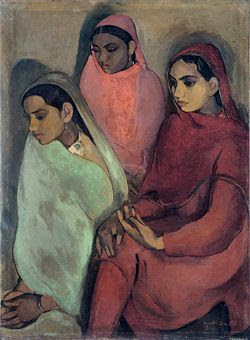
M F Hussain’s paintings inspired by Mother Teresa, landscapes in muted shades by Ram Kumar and an intensely dark work by S H Raza, colourful abstracts by V S Gaitonde stand out due to familiar names. Ritual Image, a complex piece by Nandagopal and Form, a minimal bronze piece by Sankho Choudhuri present interesting dimensions in sculptures. Jamini Roy’s stylized forms and Amrita Sher-Gill’s paintings form a fairly large collection. The museum is a good place to get familiar with art and artists.
Painting by Amrita Sher-Gill
According to the official website of NGMA it also conducts educational and cultural activities; I hope that in Bangalore, too, it will take on such a role soon. Having started off on a wrong foot, it desperately needs to re-invent its image. It is imperative that NGMA garners local support and involves active participation from the various members of the art community in the city.

(Published in Bangalore Mirror)