24 Jun 2008

Fine Art Photography

There's reason for cheer as fine art photography emerges as the next big thing

(Nalini S Malaviya)

I met a couple of local photographers, recently, as part of a search for good photographers for an online portal. One of them, Vivek Mathew is an extremely talented youngster who has had successful shows in the city. His photographs of landscapes, objects, buildings and the monsoon (reflections in puddles and so on) were simply amazing. This, in fact is a good time to be a photographer. After the art boom, fine art photography is poised to be the next big thing in the country. Although the market is still nascent at the moment, the number of exhibitions of photographs and prints has gone up exponentially in the recent past. Mumbai and Delhi markets are comparatively a lot more mature compared to Bangalore. But, here too there are a number of exhibitions of fine art photography taking place. Varied themes such as wildlife, architecture, interiors, landscapes and people are captured through the lens and are creating waves in the art circles.

Vivek Mathew
There are now dedicated galleries and portals to showcase fine art photography, which just goes to prove how the market is evolving. Many art galleries too have begun showcasing photographic prints either as an exclusive show or as part of a multi-media exhibit. There are many painters and other artists as well who are turning to photography. With their fine art background they bring a different kind of sensibility to this art form.
Worldwide, the market has been doing well for quite some time now. Sotheby’s, Christies and other international auction houses regularly hold auctions of vintage photographs. There is a growing awareness amongst collectors and investors regarding this medium, and while the market for prints might be under developed at the moment, it is one with a lot of potential.

When investing in photographs a few things that one can keep in mind are –
· Professional background of the photographer
· Edition size (less than 15 is a good idea) – the lower the better
· Use of good quality archival paper

Some of the photographers who are considered to be established and are known to be producing good quality works are Raghu Rai, Dayanita Singh, Pablo Barthomolew and Shibu Arakkal. But this list is endless, and there are many foreign photographers too who are exhibiting in India. As an emerging medium, prints are affordable at the moment, available in the price range of Rs 20,000 to a few lakhs.

(Published in Bangalore Mirror)

23 Jun 2008

Art auctions good for investors

With so many art exhibitions taking place it can be very confusing for a buyer to decide on the art, artist and the medium to buy, especially from an investment perspective . The list of artists who are talented and are producing interesting works is endless . It becomes very difficult then to narrow down one's search and zero on to a winner . Given the choice to buy from an artist directly, a gallery or at an auction, the answer would depend on factors such as budget, individual preferences and knowledge of art.
You can buy directly from an artist if that artist is selling from his studio, but this scenario is fast getting outdated . Most good artists are bound by contract from galleries and usually do not sell works privately. When picking up art by students and new artists it is a good idea to buy directly from them. Investors who are knowledgeable about art may also choose to buy directly from the artist, but one must especially look for quality and the condition of the work. In general, the woks displayed at a gallery are of a better quality, as they are often either a part of a curated show or the best from the artist's collection. When buying from a gallery look for one that has an excellent reputation , organises shows of reputed artists and has established credentials in terms of transparency in dealing and good business practises.
Painting by MS Murthy
Buying at an auction (secondary market) works well for those who are looking at art from a purely investment angle and have the requisite budget. Often one may be able to get top of the line works at an auction. Even if the prices are high (premium , commissions, taxes etc), it is well worth it. The biggest advantage is that the works come with a provenance , authenticity and are usually of good quality. When rare or an artist's best works show up at an auction there might be fierce bidding for it. But, in general, an auction is a great way to consolidate one's collection. And, for those who are looking at making the right investment , it makes sense to buy at an auction.

(Published in Financial Times)

21 Jun 2008

Grants/Aid for deserving art students

The Smart & U Visual Arts Foundation (SNUVAF), a non profit organization, based in Mumbai, India has been set up to identify, research, build, and implement programs to make the Arts a part of many more people's lives. SNUVAF would like to provide grants to deserving art students (who are residents of India) for art education (1st year BFA onwards).

For more details check out:

http://smartnu.blogspot.com/2008/06/smart-u-visual-arts-foundation-aid-for.html

17 Jun 2008

Are these prices real?

Many young artists are hiking their rates to ride the global price tide you see at auctions. But this won’t pay in the long run, says Nalini S Malaviya

A recent report made out a convincing case that Indian art is undervalued at the moment and prices will go up in the future. Is that true? If you ask the uninitiated, the answer will be ‘Indian art is already over-priced and there is no logic or sense in the million dollar deals that take place regularly, particularly at auctions’. Auction prices apart, most people find it hard to digest the prices of art even in the primary market.
Analysts look at prices from a global perspective based on which prices may be low compared to Chinese or Western art, but the fact remains that Indian art’s climb in the recent past has been spectacular. And, there’s no denying that now it has become unaffordable for many.
One of the problems that have come into focus in the recent times is the many artists trying to ride this wave by increasing their prices with every show. While this is valid for some of them, based on their performance at international shows, buyers find it irritating that students and new artists also price their works exorbitantly even in their first or second show. What they need to remember is that if they raise their prices too soon and too much, they will not be taken seriously by an art collector.

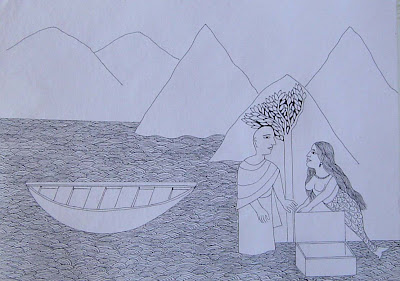
On a slightly different note, I expected more reactions to my earlier column (Till death do us art) about the German artist who was planning to use ‘death’ as a stage performance, as part of his art exhibition. Readers did react to it, but mostly on my blog and that too when I had first reported the event with a link to the original story. But strangely enough, my write-up about Badrinarayan’s drawings seemed to have irked a few readers. Now art, of course, happens to be a very subjective matter, where you may like something, which I may not and vice versa. I have also mentioned in the past, how the definition of art is expanding, and it is not always about aesthetics and beauty. But in this particular instance, what one needs to appreciate is the emphasis and efforts at popularising folk art traditions. You probably know that most folk arts such as Madhubani, Pithora, Warli, and Chittara are on the decline. Badrinarayan’s art may not be immensely cerebral but his usage of clean lines in a folk art style while presenting Indian folklore is quite commendable. Incidentally, his art is also popular at the international level.

Badri Narayan
(Published in Bangalore Mirror)

12 Jun 2008

Art Tactic - Art Market Report June 2008

Rawfacts - June 2008 Issue
The contemporary art market seems to defy gravity, and the May auctions performed generally in line with expectations. One thing is clear, the art market has polarised around the top-end, which largely appeals to recession proof buyers. But what is happening to the art further down the value chain? Anders Petterson takes a closer look at the situation.


Below is a short summary of the June issue:
Indian art market hit by econonomic woes: The overall ArtTactic Indian Art Market Confidence Indicator fell 13% from the last reading in October 2007. However, despite the fall in the overall ArtTactic Indian Art Market Confidence, the confidence in both the Modern, and Contemporary Indian art markets increased significantly, up 17% and 6% respectively.

Source: http://www.arttactic.com/