29 Oct 2009

Art on wheels

(By Nalini S Malaviya)
A car completely covered with copper trimmings and intricate designs is not a common sight. But, this is exactly what you see when you arrive at Sara Arakkal’s gallery in Whitefield. The gleaming copper reflects the afternoon sunlight, highlighting the elaborate patterns that have been so painstakingly worked upon the body of the car. Artist Yusuf Arakkal’s brainchild; he has spent the last five years in conceptualising, designing and converting his old Fiat car into a work of art. There is an interesting story behind this car. Arakkal reveals, “I got this car – a 1956 Fiat Millicento in 1986 in exchange of a couple of paintings and a sculpture from art collector Harish Padmanabha. It so happened that Harish came over to collect the paintings and we decided to have a drink to celebrate the occasion. On the way we stopped at the car workshop and the moment I saw this champagne-grey coloured car I just fell in love with it. I asked Harish if he wanted to sell it and he agreed. We settled for it and I drove back home in this car.”
Yusuf Arakkal with his artomobile
This was Arakkal’s first car in Bangalore and understandably, he has been very attached to it, and when it started to wear out, he was reluctant to part with it. Fortunately, the artist in him took over and he decided to convert it into a sculpture-cum-installation. As he wanted to retain the original classic shape of the car, he toyed with several ideas before deciding to use copper sheets to cover the car completely. Not an easy task as the final product had to be artistic as well as aesthetic.

According to Arakkal, almost a ton of copper has gone on the car in the process of altering it. A team of highly skilled craftsmen have worked on it for the last few years. A pattern inspired by wheels has been used on either side of the body of the car. Synonymous with the mobility of the vehicle and as a symbol of development and progress, the wheels are also inspired by a series of paintings Arakkal did in the 1970s. Special care has been taken to retain the patina of copper and several coats of sealant have been used to protect it from oxidation or weathering effects.

This converted vehicle - an artomobile is soon going to Delhi and will be showcased on the lawns of a new art gallery. Well, one thing is certain, this car is sure to catch your eye.

(Published in Bangalore Mirror)

14 Oct 2009

Investing in art

(By Nalini S Malaviya)


A recent report on the state of the stock market highlighted that the Sensex was climbing up in the last couple of months based on the fact that a few stocks were performing exceptionally well. A similar trend is seen in the art market, too. In the past, when prices of certain artists shot through the roof it not only created a wider market for art, but riding on this wave most of the other artists, too, hiked up their rates. And, in fact, a majority of them succeeded to a large extent. It was seen that anything related to art was on a high during that period.

However, as an investor it is important to realize that not every painting or sculpture will fetch the same returns. Incidentally, a few years ago, students and new artists were able to price their works beginning at Rs. 5,000. But soon after, the starting prices were close to Rs. 20,000. In a way, the base price itself has gone up considerably.

One question that has always emerged is that how does one evaluate whether a work of art is actually worth the quoted price. Apart from logical factors such as rarity and quality of the work, historical value, the artist’s name and its worth from a collector’s point of view, one finds that pricing is predominantly driven by demand, or, its perceived investment value.

In that respect, claims that were rampant a few years ago regarding appreciation in investment potential of art were not entirely true. Not every painting or artwork fetched the same amount of projected returns. In fact, a very small percentage of artists saw a large appreciation in price. Now that interest in art is once again rising, it helps collectors and investors to be aware of these points. Just as one invests in stocks after a lot of research, one must do the same to invest in the right kind of art. But, in case money is not a criterion, and one is not looking for a financial investment, then obviously one can just go and buy anything that is appealing.

(Published in Financial Times)

16 Sept 2009

The Indian art scene appears vibrant once again

(By Nalini S Malaviya)

After the remarkable success of the recently held India Art Summit there are many art connoisseurs who are now looking forward to the Art Expo 2009 happening in Mumbai this month. The second edition of the expo will be held on 25th to 27th September at the Nehru Center. At the moment, there are approximately 25 galleries participating in it, and a few speaker sessions have also been planned, spread across the three days. According to the organizers, the expo “is a perfect platform for launching Indian art in the international arena with meticulous selection of top galleries and well-conceived program of special exhibitions, seminars and other events.”

What makes such art events interesting, apart from the more immediate benefits such as networking, is that they offer a forum to discuss issues related to the business of art before a wider audience. Art collectors and investors also benefit hugely, not only in terms of access to information, but also in terms of access to a wide spectrum of art - all under one roof.
Talks by experts in the field, and an opportunity to interact with artists, gallerists, critics and other key members from the art fraternity add value to such events. Insights into various aspects related to the art market, such as world markets, evaluations, regulations and so on, make the event more interesting.

With the maturing of the Indian art market, and its remarkable growth in the last few years the current phase is going to be crucial in establishing credibility. The recent recessionary phase highlighted many gaps in the art market, and now that the market is poised, once again, to grow to the next level, it is in the larger interests of everyone concerned that better business practices are implemented to steer the growth in a healthy direction. In such a scenario major art events that invite participation from across the country and abroad can offer an excellent opportunity for discussing key issues along with the business side of the art scene.

If planned and executed properly such events can turn to be much more than just a networking opportunity and become a great learning experience for art connoisseurs.

(Published in Financial Times)

8 Sept 2009

Four of a kind

(By Nalini S Malaviya)
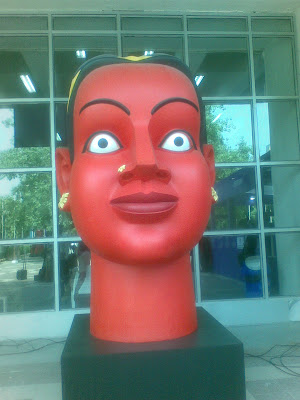
At the recently held art summit several works of art competed with one another to catch the visitor’s eye. Anish Kapoor’s installations were of course the biggest draw at the fair. Then, names such as Ravinder Reddy whose iconic Head in a brilliant red and Subodh Gupta, whose large scale installation made out of utensils created an impact right at the entrance. While, Nataraj Sharma’s humongous installation made out of metallic wire and tiny airplanes and Manjunath Kamath’s digital montage were outstanding. Apart from these well known names there were several others that were truly brilliant and that stood out either because of the thought process behind them, or they were just so spectacular that they could not be ignored. Although there were many that grabbed my attention, I have listed four of these below.
Lirio Salvador
Sandata ni Lila by Lirio Salvador
A sculptural assemblage by an artist from Philippines is essentially a guitar made out of scrap that stood against the wall at The Drawing Room, a contemporary art gallery based in Philippines. The stringed instrument was made out of gears, mixing bowls, utensils and door handles, and the interesting part of this assemblage was that visitors were encouraged to pluck at the strings. The musical instrument was a creative fusion of art and music.

Suchitra Gahlot
One Thousand Tears by Suchitra Gahlot
This installation comprised of a thousand 10 ml bottles containing artificial tears and a typewriter. Based on the replies that one thousand people gave to the question “Why did you cry last?” the vials were labeled. This installation caught my attention with its simplicity and poignancy.

El Anatsui
Black River by El Anatsui
A massive installation on the wall spanning approximately 8 feet by 12 feet made out of aluminum bottle caps and copper wire was displayed at the Sakshi Gallery. This stunning piece of work could not be ignored by any stretch of imagination.

Princess Pea
Supercalifragilisticexpialidocious by Princess Pea
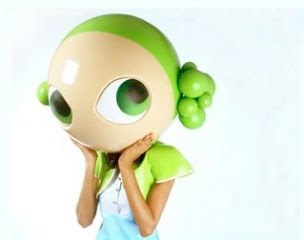
At the Rob Dean Art – a U.K. based gallery one encountered a fun and quirky series of photographs and installations that used a cartoon character to create the artworks. The stall was buzzing with activity with the artist wearing a ‘cartoon head’ while posing with the visitors, and offering everyone cupcakes. Although, the theme of the project was based on the angst that the artist faced in her growing up years as she was very thin, and was always reminded that her head was too big for her body. However, the treatment was fun and made literal use of cartoon figures. This one caught ones attention with its sense of humor, and the novelty of execution.

(Published in Bangalore Mirror)

1 Sept 2009

India Art Summit

(By Nalini S Malaviya)

Last week, I was in New Delhi to attend the second edition of the India Art Summit 2009 being held at Pragati Maidan. The VIP and media preview organised on the 19th, from 3:00 PM in the afternoon saw the who’s who from the art community get together for this much awaited event. A Sculpture Park created right at the entrance greeted visitors with its large scale sculptural installations by artists such as Navjot Altaf, G. R. Iranna, Vibha Galhotra and Ravinder Reddy
Ravinder Reddy, Image source Authoramongst others. Beginning from the foyer, installations by some of the best known names in the art business were placed strategically at various locations throughout the exhibit area. These were specially created for the summit as part of the Purple Wall Project curated by Gayatri Sinha. Installations by Subodh Gupta, Nataraj Sharma, Riyas Komu, Manjunath Kamath, T. V. Santosh and Subba Ghosh were some of the exhibits that were on display.

Subodh Gupta, Image source Author
Out of the 54 galleries participating in this year’s fair, 17 were from abroad. Lisson Gallery, London, Arario Gallery, China, Beck & Eggeling, Germany, Galerie Christian Hosp, Germany were some of the major overseas galleries. Incidentally, galleries Sumukha and Ske were the only two from Bangalore who participated in the fair. The highlight of the exhibits had to be the sculptural forms and paintings by the Mumbai born artist Anish Kapoor, who is based in London, and whose works were brought to India by Lisson Gallery. In fact, this is the very first time that his works have ever been showcased in the country of his birth.

Thukral & Tagra, Image source Author
There was so much art all around that it would be impossible to go into details of all the exhibits, but to give an idea, the variety ranged from Souza and Raza at the Delhi Art Gallery stall, drawings and etchings by Picasso at Beck & Eggeling, a large triptych by Jitish Kallat at Arario and Thukral & Tagra at Nature Morte. Apart from these names there were numerous other artists who shared space in the gallery stalls. Unfortunately, some of the larger works were displayed in such a way that there was no viewing space in front of it, which was such a pity!
There was also a video lounge and a Speaker’s Forum that included eminent personalities from the field of art, both from India and abroad.

The four day modern and contemporary art fair provided an excellent opportunity to view art by some of the best known artists from India, as well as emerging artists - all under one roof. Compared to last year, the fair this time was not only bigger in terms of scale, but the quality was also better in terms of the galleries participating in it, and the artists that were represented. Obviously, not all the exhibits can be categorized as exceptional art, but overall it was quite good and definitely an event worth visiting.
(Published in Bangalore Mirror)